Musical phrase substructures
From my own analysis of a number of video game compositions as well as some coursework, I would say there are 2 broader categories for writing phrases:
- “Through-composed”: no motif is really repeated but it feels like it’s a coherent, singable melody
- A primary motif (PM) “alternates” with one or more secondary motifs (SM, SM1, SM2)
- PM | SM
- PM | PM | SM | SM
- PM | PM | PM | SM
- PM | PM | SM | PM
- PM | SM | PM | SM
- PM | SM | PM | PM
- PM | X | PM | X
- PM | SM
Examples
Through-composed
Pallet Town Theme
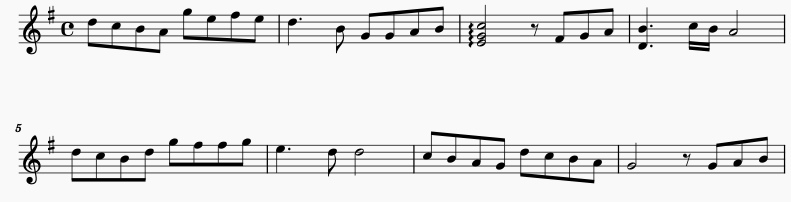
Here’s the melody to the A section of “Pallet Town” from Pokemon R/B/Y. m1-m4 is a phrase, m5-m8 is another phrase. (This would be an example of a period.) This melody as a whole is recognizable to many, many gamers, though arguably m1-m2 + the first half of m3 is what people would flock to if they were asked to sing it.
There are no melodic fragments in here that repeat, except maybe for the ends of m2 and m3, but the 2nd half of m3 acts more as a pickup into m4, and the 2nd half of m2 is more of its own statement since it includes beat 3.
Littleroot Town
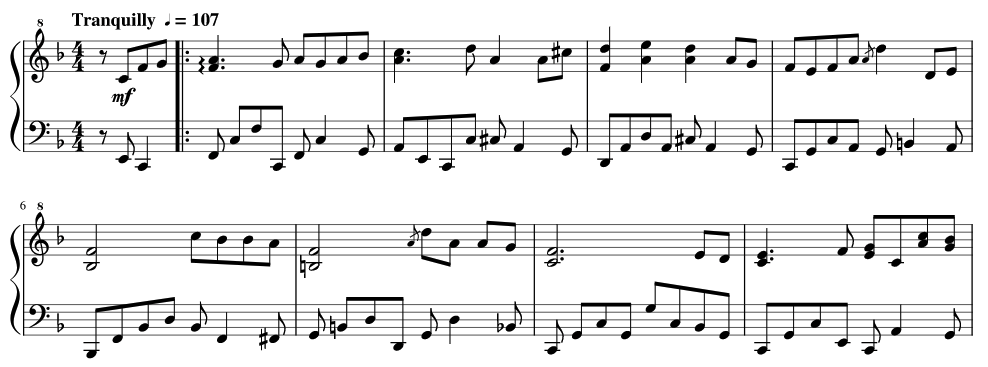
Here’s the melody for the A section of “Littleroot Town” from Pokemon Ruby/Sapphire. The second half of this melody has an obvious motif, but the first half doesn’t seem to have any repeated motivic ideas!
PM | SM
Super Mario Bros Main Theme (A Section)
This melody is wonky but it seems to have 2 main ideas: m1-m2 and m3-m4

PM | PM | SM | SM
Gusty Garden Galaxy (A Section)
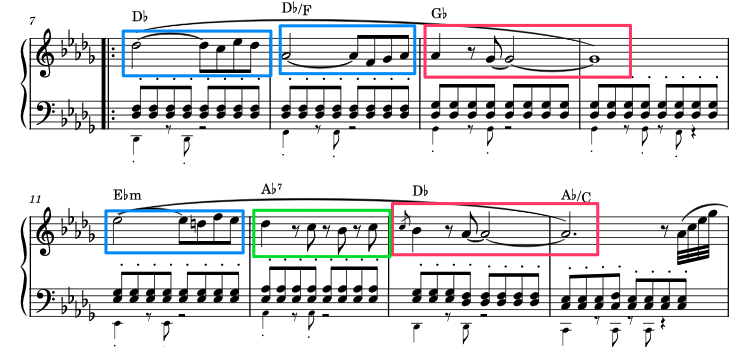
Thoughts:
The blue parts could be considered fragments and 2 bars could be 1 motif- nah I no longer think this is the case. blue is a motif on its own.
- Green is a kinda modified version of blue
- This is a parallel period
PM | PM | PM | SM
PM | SM | PM | SM
Pokemon Center
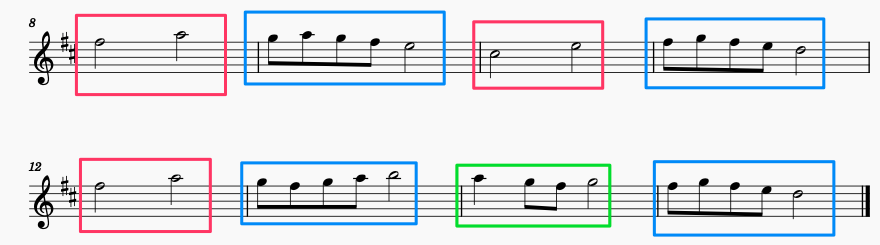
This is the B section melody. It is really, really simple.
- m8-m11 is one phrase, m12-m15 is another phrase
- the whole B section is a parallel period
- m8 and m12 are identical
- m10 is a sequence of m8
- m11 is sequence of m9
- m13 is an inversion of m9, which helps lead it to a melodic climax
- m14 is a new idea
- m15 is the same as m11
Super Mario Bros Main Theme (B Section)
This one is more understandable than the A section.
- m7, m9, m11 are exact repetitions
- m8, m12 are exact repetitions
- this is a parallel period
- m10 and m13-m14 are unique ideas
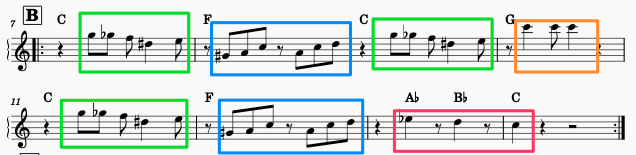
PM | PM | SM | PM
Super Mario Bros Main Theme (D Section)
- m7, m9, m11 are exact repetitions
This one is a bit questionable, it could be like “PM | SM1 | SM2 | SM1”, but the rhythms are so similar between Green and Pink (in the screenshot). Pink is a simple variation of Green: the first 3 notes are the same rhythm but the last note changes place. The pitches are very different.
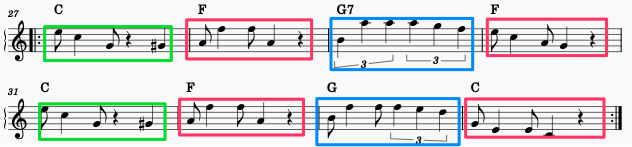
PM | SM | PM | PM
Aquatic Ambiance
- Pink is the primary motif!
- in m28 and m29 the intervals are different
- Blue is a longer “phrase”
- Green is the same rhythm as pink though a bit shorter in duration
- Orange is the second “half” of green (the 16th note into a longer note that isn’t on a beat)
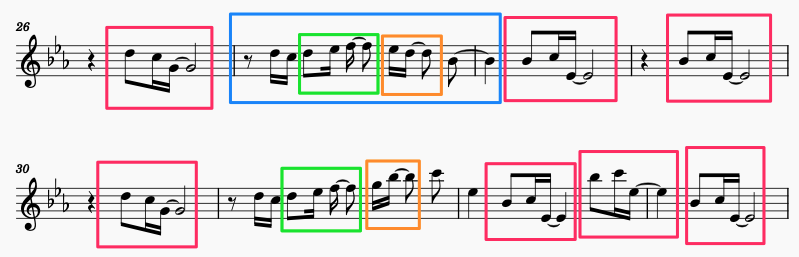
PM | X | PM | X
Pokemon Center
This is the melody to the A section of “Pokemon Center” from Pokemon R/B/Y. It’s a single idea, repeated twice, with a brief pause in between. You could argue that there are really 2 motifs here (#1 the notes 1-4, #2 is notes 4-8) but I would instead call each of those fragments or germs (as Schoenberg does). I would think that if one were to sing this theme, they would sing the 8 notes as a whole.
