Modulation
In digital signal processing, modulation is the act of modifying a property of a waveform (the carrier signal) based on another waveform (the modulation signal). The modulation signal is the information that is desired to be sent, and the carrier signal is just a way to transmit it (carry it).
First let’s understand what that could look like. Changing a waveform’s amplitude over time is an example:
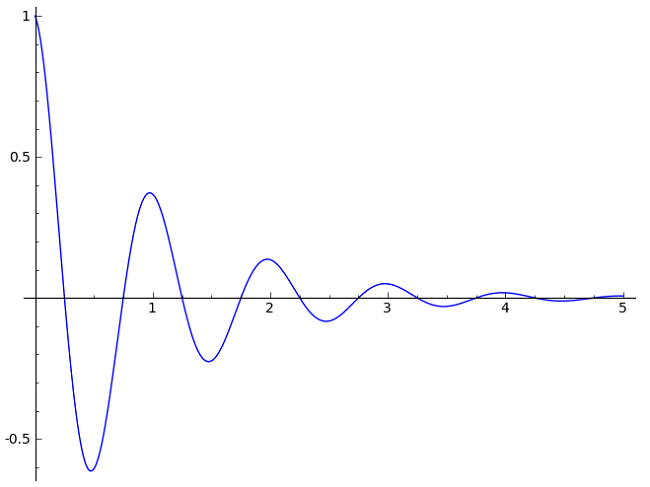
The process is fairly simple:
- Define your carrier signal waveform (for example, a sine wave)
- Pick your modulation method (e.g. amplitude)
- Create a new function that incorporates the carrier signal with the modulation signal
When this combined waveform reaches the destination, we can extract the modulation signal using a demodulator. That’s a bit beyond the scope of what I want to discuss here though…
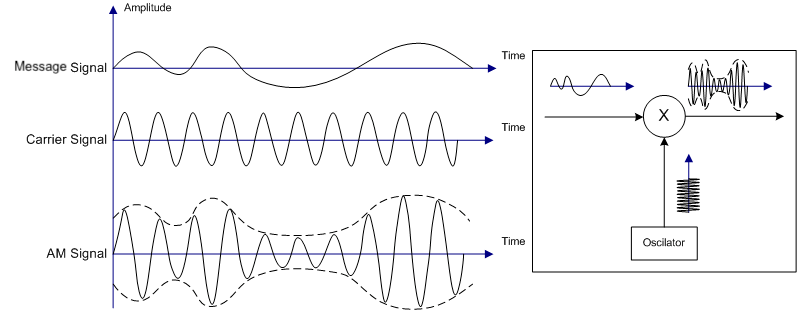
By Ivan Akira - Own work, CC BY-SA 3.0, https://commons.wikimedia.org/w/index.php?curid=9820131
For audio it’s important to understand PCM and PAM:
- PAM is when the carrier wave is digital and the modulation signal is analog
- PCM is when the carrier signal is digital and the modulation signal is digital