Fragmentation
Fragmentation is the “fragmenting” (breaking into smaller pieces) of given melodic material.[1] By fragmenting said material and then repeating it, it can feel like a kind of increase in intensity.
A quintessential example of this is in Beethoven’s Piano Sonata Op.2, No. 1.
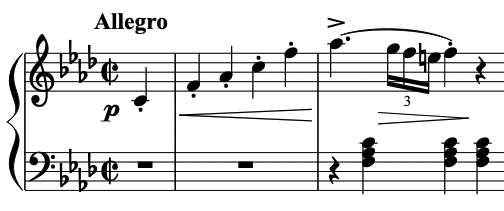
This basic idea can be split into 2 motifs:
- The rising arpeggio
- The dotted quarter note followed by a quick turn
This can be considered “fragmenting” the basic idea.
This technique was first named explicitly in caplin-2013 in the context of Classical music. It is often used to fragment the basic idea in a sentence. It is regarded as the most “typical sign” of the continuation function.[1]
It is worth emphasizing that the melodic material can be brand new and not be related to the previously stated melodic material, i.e. that of the basic idea.[2] As long as the fragments are smaller “units of material” (meaning that they must also be clearly differentiated[1]), it can be considered fragmentation.
While fragmentation is a key component of the sentence, which is regarded as the most important theme type in Classical music[3], this technique is seen in video game music1, anime music2, film music3, and others.
Footnotes:
1 – See Ryan Leach’s video on sentence form in Mario music here. Listen to “Mario 2 Overworld”, “The Forest of Illusion”, “Mario 64 File Select”, “Good Egg Galaxy”, “Double Cherry Pass”, “Bubblaine”.
2 – See Ryan Leach’s video on how sentence form works here. Listen to his analysis on “Spirited Away” by Joe Hisaishi.
3 – See Mark Richard’s paper on different theme types in film music here.
References:
[1]: caplin-2013 p.48
[2]: caplin-2013 p.51
[3]: caplin-2013 p.33