Harmonic functions
In music theory, the harmonic function of a chord is a descriptor of how that chord tends to progress to other chords. That is, a chord’s function describes its purpose.
Common practice period
Harmonic function in Western tonal music during the common practice period can be summarized by 3 separate functions:
- Tonic function
- Predominant function: wants to move to a dominant function chord
- Dominant function: wants to move to a tonic function chord
Tonic function chords are unique in that:
- It’s fine to stay on a tonic function chord and not go anywhere – variety can be created using prolongational methods
- They can move to a predominant function chord
- They can move to a dominant function chord
You will see exceptions to these kinds of movements during this period: for example, the plagal cadence.
Here’s some handy flowcharts.
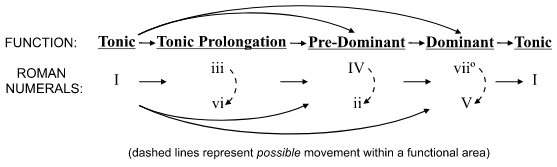
In major keys.
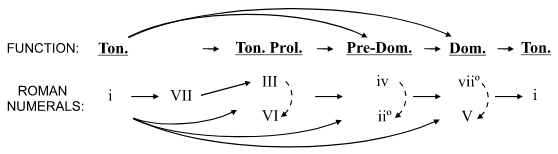
In minor keys.
The axis system
lendvai-1971 describes a new system of harmonic functions unique to the work of Bela Bartok: see axis system.
Modal music
TODO: clean up my thoughts here
- modal music is still tonal
- tonal implies a tonic
- tonic implies you can move away from the tonic and come back to it
- tension + resolution
- chords in a mode of a major scale will not have the same harmonic function as the major scale chords’ functions
- for example in D Dorian: the V is actually
Vm=Am. Dorian progressions are usually something likeIm - IV. Basically any other chord will not feel like home, especially if using a pedal point…
- for example in D Dorian: the V is actually