Authentic cadential progression

The information on this page may be skewed – click here for details.

The info on this page is either entirely based on or mostly based on the content published in caplin-2013 or caplin-1998. Caplin is considered to be responsible for reviving interest in the analysis of form in North American music theory.

While Caplin's impact cannot be understated, it is worth understanding that his 1998 work (and his 2013 followup) are focused on Classical music: particularly the works of Haydn, Beethoven, and Mozart. It is important to not assume other styles of music (both preceding and following the classical era, or music in other parts of the world) follow these same conventions. Music theory is descriptive, not prescriptive, and so the theory you see describing what was common in the Classical era may not apply to anything else.

An authentic cadential progression is a cadential progression where both the dominant harmony and the final tonic harmony are in root position. The tonic is the "goal" of this progression.[citation needed]1

An authentic cadential progression is said to be complete if it has:

  • an initial tonic harmony;
  • a predominant harmony;
  • a dominant harmony;
  • a final tonic harmony

Examples

Example 1

This progression is complete.
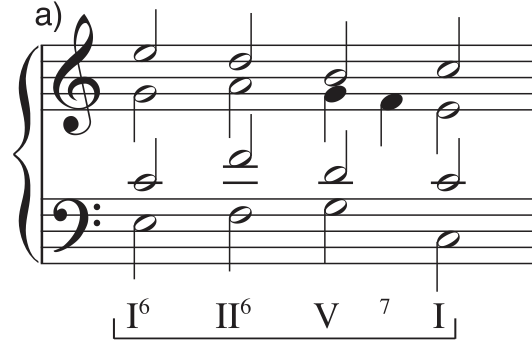
Pasted image 20221007175747

Example 2

– add an incomplete authentic cadential progression