Fragmentation
Fragmentation is the "fragmenting" (breaking into smaller pieces) of given melodic material.1 By fragmenting said material and then repeating it, it can feel like a kind of increase in intensity.
A quintessential example of this is in Beethoven's Piano Sonata Op.2, No. 1.
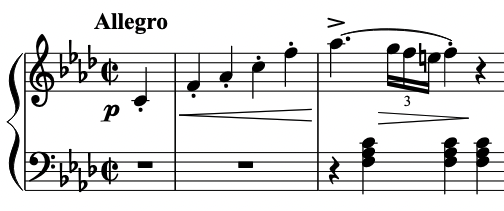
This basic idea can be split into 2 motifs:
- The rising arpeggio
- The dotted quarter note followed by a quick turn
This can be considered "fragmenting" the basic idea.
This technique was first named explicitly by Caplin in the context of Classical music. It is often used to fragment the basic idea in a sentence. It is regarded as the most "typical sign" of the continuation function.1
It is worth emphasizing that the melodic material can be brand new and not be related to the previously stated melodic material, i.e. that of the basic idea.2 As long as the fragments are smaller "units of material" (meaning that they must also be clearly differentiated1), it can be considered fragmentation.
While fragmentation is a key component of the sentence, which is regarded as the most important theme type in Classical music3, this technique is seen in video game music4, anime music5, film music6, and others.